FIRE (financial independence, retire early) planning reduces to two numbers: the portfolio you would need in order to live off its withdrawals, and how long it takes to build that portfolio from where you are now. Our FIRE Calculator computes both from six inputs. This guide shows exactly what it does with them, gives tables you can use to see which assumptions matter most, and lists what the model leaves out.
Note: this is educational information, not financial advice. The calculator assumes a constant return and constant spending. Real markets, taxes and life do not behave that way.
What the calculator calculates
There are two formulas. Both were reproduced independently in Python and matched the tool's output on every case we compared.
FIRE number = annual expenses in retirement / withdrawal rateA 4% withdrawal rate is the same as saving 25 times your yearly spending, which the tool shows as "25.0× annual expenses". At $40,000 a year and 4% the FIRE number is $1,000,000.
Years to FIRE come from a month-by-month simulation. Starting from your current savings, each month the balance first earns interest at return / 12, then one twelfth of your annual contribution is added. The loop stops in the first month the balance reaches the FIRE number. The result is shown as months divided by 12, to one decimal.
each month: balance = balance × (1 + return/12) + annual contribution / 12Three details follow from this. The annual return is treated as a nominal rate compounded monthly, so 5% grows to about 5.12% over a full year. Contributions are added at the end of the month. And the contribution never changes during the projection, so there are no raises or step-ups unless you rerun the tool with new numbers.
Using the calculator step by step
- Currency. Choose US Dollar, Euro, British Pound or Australian Dollar. This only changes the symbol; no conversion happens.
- Current Age. Used only to turn "years to FIRE" into a projected age.
- Current Savings. What you have invested toward this goal today. An empty box is silently treated as 0.
- Annual Savings/Contribution. What you add per year, in total.
- Annual Expenses in Retirement. What you expect to spend per year once retired. This, not your income, sets the target.
- Expected Annual Return (%). The field is tagged "Real, after inflation". Enter a return that already has inflation taken out (for example 7% nominal minus 2% inflation is roughly 5%), so that your expenses stay constant in today's money for the whole projection.
- Safe Withdrawal Rate. Pick 3%, 3.5%, 4% or 5%. The default is 4%.
Results update as you type; there is no calculate button. Below the results card the tool shows a comparison of all four withdrawal rates and a yearly progress table.
A worked example
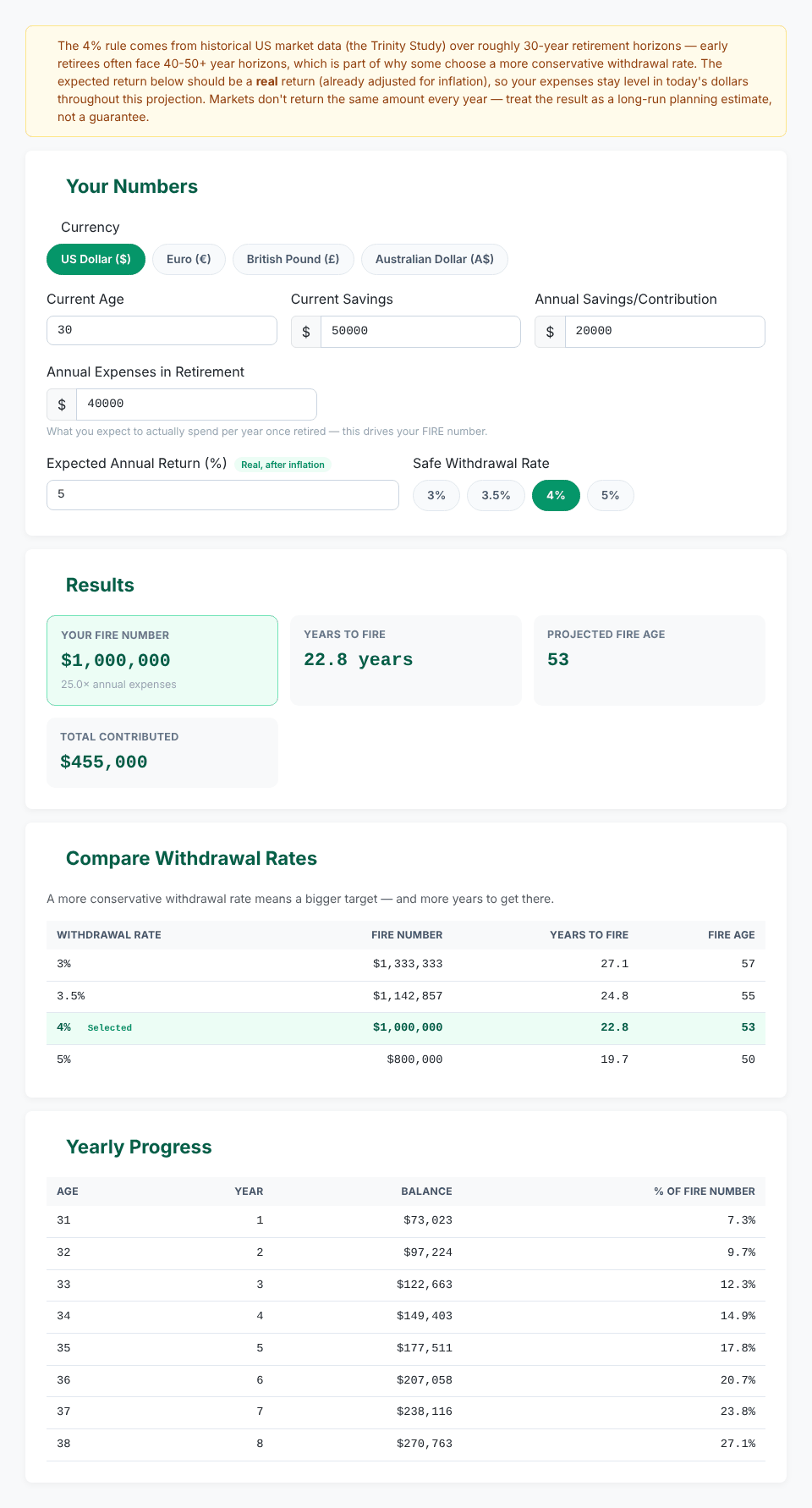
Take the calculator's default inputs: age 30, $50,000 saved, $20,000 added each year, $40,000 of retirement spending, a 5% real return and a 4% withdrawal rate.
FIRE number        $1,000,000   (25.0× annual expenses)
Years to FIRE      22.8 years   (273 months)
Projected age      53
Total contributed  $455,000     (273 months × $1,666.67)
Total Contributed counts only what you add, not your starting $50,000. The remaining $495,000 of the target comes from the starting balance plus investment growth. The comparison table for the same inputs:
Withdrawal rate   FIRE number    Years   Age
3%                $1,333,333     27.1    57
3.5%              $1,142,857     24.8    55
4%                $1,000,000     22.8    53
5%                $800,000       19.7    50
The yearly table lists the balance at the end of each full year as a share of the target: 7.3% after year 1 ($73,023), 34.1% after year 10 ($341,154) and 94.9% after year 22 ($948,789). The table ends at year 22 because it only records completed years. The last 9 months of the 273 are not listed, which is why the final row stops short of 100%.
Run your own numbers
Open the FIRE CalculatorWhich input matters most? Sensitivity tables
The tables below change one input at a time from the same base case (age 30, $50,000 saved, $20,000 a year, $40,000 spending, 5% real return, 4% withdrawal rate: 22.8 years). We checked each row against the tool; some were run in the tool directly and the rest were computed with the same formula.
Spending
Spending/yr   FIRE number    Years   Age
$30,000       $750,000       18.8    49
$40,000       $1,000,000     22.8    53
$50,000       $1,250,000     26.1    56
$60,000       $1,500,000     28.9    59
Each extra $10,000 of yearly spending adds $250,000 to the target at 4% and between 2.8 and 4.0 years to the timeline in this table (4.0, 3.3, then 2.8). Spending only changes the target. If you want to model "I will spend less while I save", you also have to raise the contribution yourself.
Annual contribution
Saved/yr   Years   Age
$10,000    31.5    62
$20,000    22.8    53
$30,000    18.1    48
$40,000    15.1    45
Doubling the contribution from $20,000 to $40,000 cuts the timeline by 7.7 years, but it does not halve it. The starting balance and the growth on it do part of the work either way.
Real return
Return   Years   Age
0%       47.6    78
3%       28.3    58
5%       22.8    53
7%       19.3    49
At a 0% return the tool simply adds contributions until they cover the gap, which takes 47.6 years here. The difference between a 3% and a 7% assumption is 9 years, which is why running several returns is more honest than relying on one.
Starting savings
Savings      Years   Age
$0           25.2    55
$50,000      22.8    53
$100,000     20.7    51
$250,000     15.4    45
Taken together, spending and the withdrawal rate move the target; contribution and return move the speed. Because the target is a multiple of spending, a lower-spending life helps twice: it lowers the number and, if the savings come from the same income, it usually raises what you can set aside.
Choosing a withdrawal rate
The tool's own notes explain that the 4% rule comes from a 1998 analysis of historical US stock and bond returns over about 30-year retirements, and that people retiring much earlier need their money to last longer, which is why some pick 3.5% or 3%. We have not re-tested those studies and do not make claims about success rates. What the tool lets you do is see the price of caution: in the base case, moving from 4% to 3% adds $333,333 to the target and 4.3 years to the timeline.
The tool's withdrawal rates are fixed to four buttons. If you want a different figure, such as 3.25%, you can divide your spending by that rate yourself, or fold it into the expenses field: expenses of $40,000 at 4% give the same $1,000,000 target as expenses of $32,500 at 3.25%. Choose the 4% button and enter the adjusted spending.
Coast FIRE with the same tool
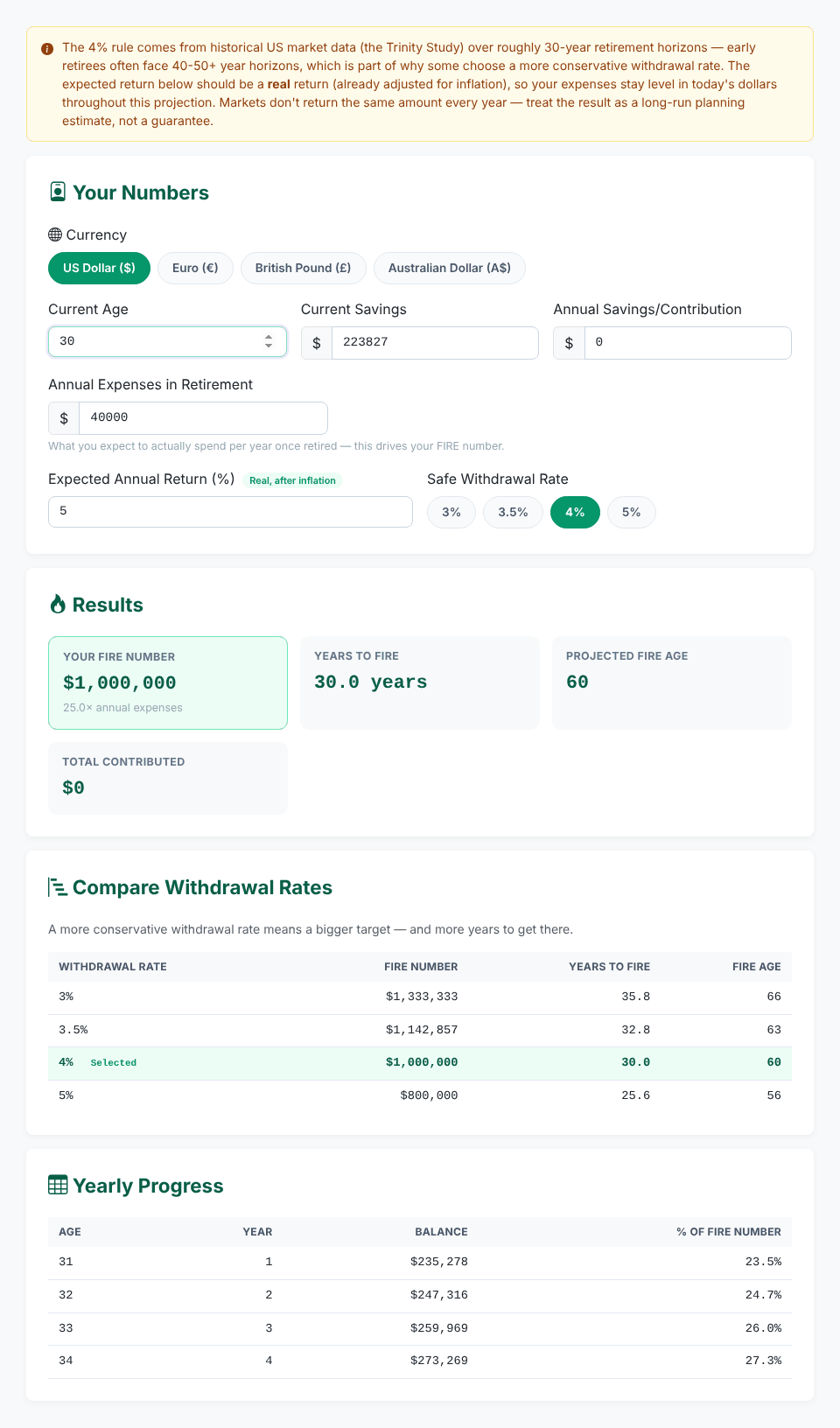
"Coast FIRE" asks a different question: how much do you need today so that, with no further saving, the balance grows into the FIRE number by a chosen age? The tool has no coast mode, but setting Annual Savings/Contribution to 0 turns it into one, because the result is then simply how long your current savings take to reach the target by growth alone.
Examples at age 30, $40,000 spending, a 5% real return and a 4% rate (a $1,000,000 target), with contribution 0:
Savings today   Years to reach $1,000,000   Age
$100,000        46.2                         76
$200,000        32.3                         62
$300,000        24.2                         54
To reach the target at a specific age, divide the target by the growth factor. For 30 years at 5% compounded monthly the factor is (1 + 0.05/12)^360, and $1,000,000 divided by it is $223,827. We entered $223,827 with contribution 0 and the tool reported exactly 30.0 years, age 60. For 20 years the same arithmetic gives about $368,645 and for 35 years about $174,407.
Coast numbers still assume that you would keep paying your living costs from earned income. They say nothing about whether that income exists.
Mistakes and messages to expect
- Entering a nominal return. If you enter 7% while expenses are in today's money, the projection overstates your progress because it ignores inflation. Subtract expected inflation first.
- Already there. If your savings are at or above the target, the tool shows "Already there!" for years, your current age, and $0 total contributed. The yearly table is hidden. The comparison table still shows how long other rates would take (with $1,000,000 saved and 40,000 spending, the 3% row shows 5.8 years).
- "At this savings rate and return, reaching your FIRE number would take over 100 years — try increasing your contribution or reviewing your assumptions." This appears when the simulation hits its 1,200-month cap, for example with $0 saved and $0 contributed, or with a 0% return and a $100 yearly contribution. All result cards are hidden when it shows.
- "Please enter a valid current age." appears when the age box is empty. "Please enter annual expenses greater than zero." appears for empty or zero spending. "Current savings cannot be negative." and "Annual contribution cannot be negative." appear for negative numbers.
- "Please enter a valid, non-negative expected return." appears for a negative return. This means you cannot model a period of falling real value; use 0 as the floor.
What the model does not do
- No taxes, investment fees, pensions, Social Security or healthcare cost changes. The tool's About text says the same.
- No market volatility. A constant return hides sequence risk, meaning that poor returns early in retirement can hurt more than the same returns later.
- The target is just spending divided by the rate. The tool does not simulate the withdrawal phase or check that a portfolio would last.
- Contributions are flat. If you expect to save more as your income grows, run the tool again with a higher figure to see the effect.
- The final month overshoots slightly. The simulation stops in the first month at or above the target, so with $0 saved, a 0% return and $50,000 a year toward a $1,000,000 target, the tool shows $1,004,167 contributed.
- Age is not range-checked. We entered 150 and the tool returned a projected age of 173, so check your own entries.
The calculation runs entirely in your browser. We read the tool's code: the only network request it can make is the optional feedback form in the Contact tab, which sends what you type there when you submit. Nothing in the inputs is uploaded. As with any web page, the site itself loads shared scripts and styles (the Bootstrap library from a public CDN, and possibly advertising scripts), which are separate from the calculator.
Quick answers
Why does the FIRE number not depend on my income? Because it is spending divided by the withdrawal rate. Income only matters through how much you can save, which you enter as the contribution.
What does "Real, after inflation" mean? It means the return you type has inflation subtracted, so the projection stays in today's money and you do not need to inflate your spending each year.
Why do the years have decimals? Months are divided by 12 and rounded to one decimal. 273 months is 22.75, shown as 22.8 years. The projected age is rounded to a whole number.
How accurate is the age? It is the age you entered plus the decimal years, so it is only as good as your assumptions. Use the sensitivity tables above as a range, not a date.
Where should I go next? To see how a single lump sum grows, use the Compound Interest Calculator. For a smaller target with a deadline, try the Savings Goal & Milestone Planner.
Run your own numbers
Open the FIRE Calculator